How to Crochet a Cardigan Step by Step (Beginner Panel Method)
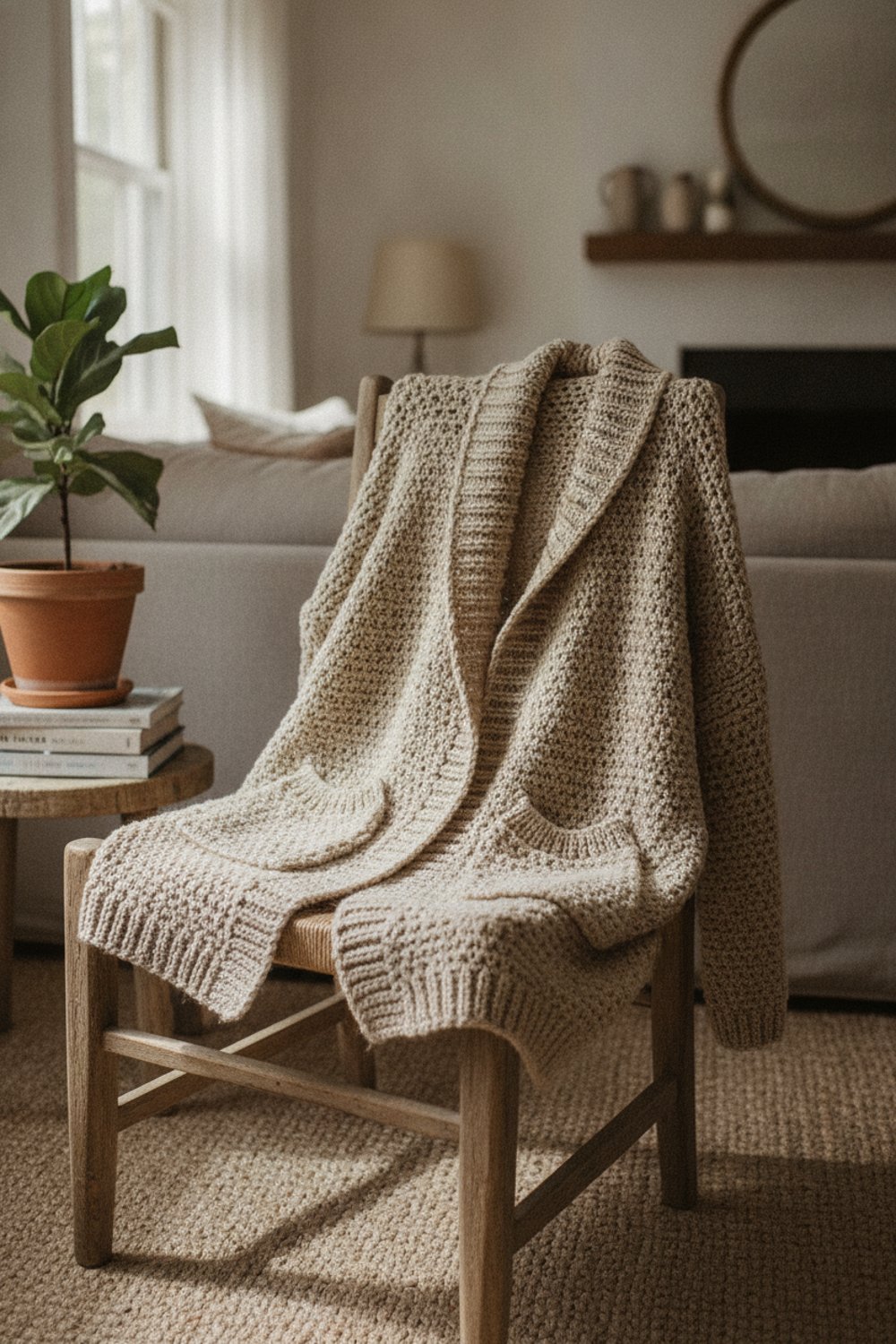
A crochet cardigan is one of the most useful things you can make. You can throw it over a tee in fall, layer it over a dress in spring, and wear it around the house all winter. The good news is that the easiest cardigans are built from simple flat panels, so you do not need advanced skills.
This guide breaks a basic open-front cardigan into clear steps: one back panel, two front panels, two sleeves, and a ribbed collar. We also link two free, tested beginner patterns so you can follow exact numbers if you prefer.
What You’ll Need
- Worsted weight (#4) yarn, roughly 1,000 to 2,000 yards depending on size and length
- Crochet hooks in two sizes, for example 6 mm (J) and 6.5 mm (K)
- Locking stitch markers
- Soft measuring tape
- Yarn needle for seaming
- Scissors
- Blocking mats and T-pins
How a Beginner Cardigan Is Built
Most easy cardigans use the same plan:
| Piece | Shape | How many |
|---|---|---|
| Back | Rectangle | 1 |
| Fronts | Narrower rectangles | 2 |
| Sleeves | Rectangles or slightly tapered pieces | 2 |
| Collar / front band | Long strip of ribbing | 1 |
| Pockets (optional) | Small squares | 2 |
Ashleigh’s Everyday Crochet Cardigan from Sewrella is a good example. It is rated Level 2 Easy, uses worsted yarn and a 6.5 mm (K) hook, and is made from rectangle pieces sewn together with chunky ribbing at the hem and neckline.
Step 1: Measure and Pick Your Size
Step 1: Measure your bust at the fullest point. Add ease for the fit you want. Lion Brand’s ease guide suggests 2–4 inches for a standard fit, 4–6 inches for loose, and 6 inches or more for oversized. Most crochet cardigans are made loose or oversized.
Step 2: Measure from the top of your shoulder to where you want the hem to fall. A hip-length cardigan and a long duster need very different amounts of yarn, so decide this first.
Step 2: Swatch for Gauge
Step 3: Make a swatch at least 6 inches square in the main stitch. Half double crochet is the most common choice for easy cardigans. Wash and dry it, then count stitches and rows in 4 inches.
Step 4: Compare your numbers to the pattern gauge. Too many stitches? Go up a hook size. Too few? Go down one. Do not skip this. A small gauge difference adds up to several inches across a whole cardigan.
Step 3: Crochet the Back Panel
Step 5: Chain enough stitches for half of your finished bust measurement (bust plus ease, divided by 2). Work rows in your main stitch.
Step 6: Keep going until the panel reaches your shoulder-to-hem length, minus the depth of any ribbing you plan to add later.
Step 4: Crochet the Two Front Panels
Step 7: Each front panel is usually narrower than half the back. That is because the collar band fills the gap in the middle. Follow your pattern’s numbers here.
Step 8: Make both fronts the same length as the back. Count rows on each piece and write them down.
Step 5: Seam the Shoulders and Sides
Step 9: Lay the back flat, right side up. Place the fronts on top, right sides down, with the outside edges lined up. Seam across the tops of the shoulders.
Step 10: Measure down from the shoulder for the armhole and place a marker on each side. Seam from the marker to the hem. Try the cardigan on before you sew the second side.
Step 6: Make and Attach the Sleeves
Step 11: You can work sleeves two ways. Make them flat and sew them in, or join yarn at the armhole and crochet them in rounds. Working into the armhole means less sewing, which is why many beginner patterns use it. Make & Do Crew’s Long Crochet Duster Cardigan is one example: the sleeves are worked straight into the armholes with a few simple decreases.
Step 12: Decrease slowly as you go down the arm so the sleeve does not bag at the wrist. Try it on often.
Step 7: Add Ribbing, Collar and Pockets
Step 13: Work ribbing along the bottom hem and cuffs. Back loop single crochet and front/back post stitches are both popular choices.
Step 14: Add a long band of ribbing up one front, around the back neck, and down the other front. This becomes your collar. Pull it slightly as you join so it does not ripple.
Step 15: Crochet two small squares and whip stitch them on as pockets, if you want them.
Step 16: Weave in all ends and block the cardigan flat to dry.
Free Beginner Cardigan Patterns to Follow
- Habitat Cardigan by Make & Do Crew — a free beginner cardigan with photo and video tutorials. It uses Lion Brand Heartland (#4) with 6.6 mm (K) and 6 mm (J) hooks, in sizes S/M to 2XL/3XL.
- Everyday Crochet Cardigan by Sewrella — Level 2 Easy, worsted weight, 6.5 mm (K) hook, sizes XS to 3XL.
- Briar Oversized Pocket Cardigan by For The Frills — beginner/easy, worked mostly in half double crochet with a video tutorial.
Common Mistakes (and How to Fix Them)
- Fronts do not meet in the middle. The collar band is meant to fill that space. Fix: make the band wider, or add a few more rows to each front.
- Collar ripples or flips. You picked up too many stitches along the front edge. Fix: undo the band and pick up fewer stitches, or use a smaller hook.
- Collar pulls the fronts up. You picked up too few. Fix: add stitches evenly and redo.
- Back and fronts are different lengths. Fix: always count rows, not just inches.
- Sleeves look too wide at the cuff. Fix: add a few more decrease rounds, or use a smaller hook for the cuff ribbing.
Tips
- Use stitch markers at the start and end of every row to keep edges straight.
- Make your sleeves at the same time, row for row, so they match.
- Steam or wet block each panel before seaming. It makes the seams much neater.
- A heathered or tweed yarn hides small stitch mistakes better than a bright solid color.
- Keep a little notebook with your stitch counts so you can make it again.
- If you are nervous about seaming, choose a pattern where the sleeves are worked from the armhole.
FAQ
How many skeins do I need for a crochet cardigan?
It depends on size, length and stitch. As real examples, Sewrella’s Everyday Cardigan uses 5 to 8 skeins of a 207-yard worsted yarn, and Make & Do Crew’s Habitat Cardigan uses 6 to 8 skeins of Lion Brand Heartland. Always check your pattern and buy one extra skein.
What is the easiest stitch for a crochet cardigan?
Half double crochet is the go-to. It works up quickly, makes a soft fabric that is not too holey, and is easy to count. Many free beginner cardigans use it for the whole body and add simple ribbing at the edges.
Can I make a cardigan without seaming?
Yes, partly. Some patterns are worked in one piece up to the armholes, then split for the fronts and back, and the sleeves are crocheted right into the armholes. You will usually still have a shoulder seam, but it is short and easy.
Take it one panel at a time, and your cardigan will come together faster than you expect.