How Much Yarn for a Crochet Sweater? (Charts and Real Examples)
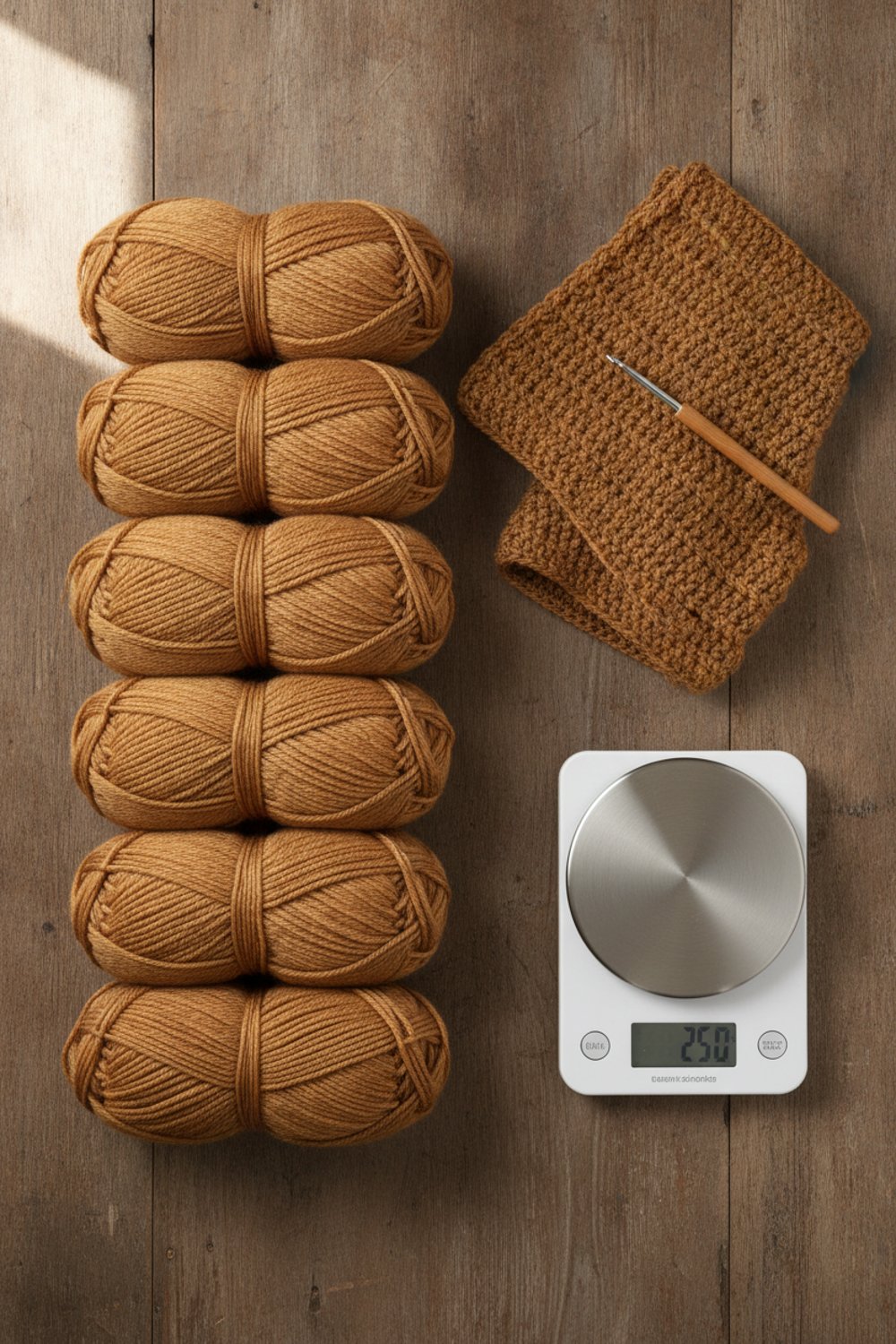
Running out of yarn two inches before the end of a sleeve is a special kind of pain. Buying three extra skeins you never use is not great either. So how much yarn do you really need for a crochet sweater?
The honest answer is “it depends,” but you can get very close. This guide gives you a general yardage chart by yarn weight, real numbers from free crochet sweater and cardigan patterns, and a simple way to estimate your own yarn needs if you are designing or changing a pattern.
What You’ll Need
- Your pattern (the best source of yardage)
- A kitchen scale that measures grams
- Measuring tape
- Crochet hook for swatching
- Calculator or phone
- One test skein of your chosen yarn
General Yardage Chart by Yarn Weight
Lion Brand’s help article “How much yarn do I need to make a ____?” gives these estimates for an adult sweater:
| Yarn weight | Adult sweater (yards) |
|---|---|
| #2 Fine / Sport | 1,750–2,625 |
| #3 Light / DK | 1,500–2,250 |
| #4 Medium / Worsted | 1,125–1,625 |
| #5 Bulky | 950–1,125 |
| #6 Super Bulky | 825–1,125 |
Source: Lion Brand Yarn support. These are general numbers that cover both knitting and crochet. Treat them as a starting point, not a promise.
Real Yardage From Free Crochet Patterns
Here is what some popular free patterns actually call for. Notice how much the numbers change with size, length and style.
| Pattern | Yarn weight | Yarn needed |
|---|---|---|
| Easy Crochet Pullover Sweater, Jenny & Teddy | #4 worsted | About 930 yards (size S–M) |
| Everyday Crochet Cardigan, Sewrella | #4 worsted | 5–8 skeins of 207 yards (about 1,035–1,656 yards) |
| Habitat Cardigan, Make & Do Crew | #4 worsted | 6–8 skeins of Lion Brand Heartland, 251 yards each (about 1,506–2,008 yards) |
| Long Crochet Duster Cardigan, Make & Do Crew | #4 worsted | 7–12 skeins of Lion Brand Heartland, 251 yards each (about 1,757–3,012 yards) |
| Movie Night Cocoon Cardi, Two of Wands | DK | About 1,116 yards (one size) |
| Granny Square Cardigan, Joy of Motion Crochet | #4 worsted | About 744–1,182 yards main color, plus under 197 yards each of 5 contrast colors |
A long duster can use almost twice as much yarn as a cropped pullover, even in the same yarn.
What Changes How Much Yarn You Need
- Size. Bigger sizes need more yarn. The jump between the smallest and largest size is often 50% or more.
- Length. Cropped, hip length and long duster styles use very different amounts.
- Sleeves. Long sleeves can use as much yarn as a whole front panel.
- Stitch. Dense, short stitches like single crochet use more yarn for the same area than taller, more open stitches like double crochet.
- Texture. Bobbles, puff stitches, cables and front post ribbing eat yarn fast.
- Ease. An oversized fit means more fabric, so more yarn.
- Colorwork. Several colors often means buying extra of each, since you cannot use exact partial skeins.
Thicker Yarn, Fewer Yards (But Not Fewer Grams)
Look back at the Lion Brand chart. Bulky sweaters need fewer yards than DK sweaters, because each stitch is bigger and covers more space. That does not mean a bulky sweater is lighter or cheaper. Bulky skeins usually have far fewer yards per skein, so you can still end up buying a lot of skeins.
This is why counting skeins is risky when you swap yarns. Always compare total yards. If your pattern calls for 1,400 yards of worsted and you want to use a different worsted yarn, divide 1,400 by the yards on your new label. That tells you how many skeins to buy, no matter what the old pattern said.
How to Estimate Yarn for Your Own Sweater
If you are changing a pattern or designing your own simple sweater, try this weight method.
Step 1: Make a swatch, about 6 x 6 inches, in your main stitch and yarn.
Step 2: Weigh the swatch in grams. Then measure its area: width times height in square inches.
Step 3: Work out the total area of your sweater pieces. For a simple drop-shoulder sweater, add up the front, the back, and two sleeves (measure each as a rectangle).
Step 4: Divide the sweater area by the swatch area, then multiply by the swatch weight. That gives you the estimated total grams.
Step 5: Check your yarn label for grams per skein. Divide your total by that number and round up.
Step 6: Add about 10–15% for ribbing, seaming, edging and peace of mind.
Example: A 6 x 6 inch swatch (36 sq in) weighs 8 g. Your sweater pieces add up to 1,800 sq in. 1,800 ÷ 36 = 50, and 50 × 8 g = 400 g. With 15% extra, that is 460 g. With 100 g skeins, buy 5 skeins.
Common Mistakes (and How to Fix Them)
- Comparing yards to grams. Patterns list yards; labels may list grams first. Fix: always compare yards to yards.
- Substituting a yarn without checking yards per skein. Two 100 g skeins can have very different lengths. Fix: count total yards, not skeins.
- Buying exactly the listed amount. Gauge differences can push you over. Fix: buy one extra skein, and check the store’s return policy.
- Mixing dye lots. Fix: buy all your yarn at once, and check the dye lot on every label.
- Forgetting the edging. Ribbing and collars add up. Fix: include them in your estimate.
Tips
- Weigh your remaining yarn when you finish the body. You will know right away if the sleeves will fit.
- Work both sleeves at the same time from two balls, so they match and you can see if you are short.
- If you are running low, make the cuffs or collar in a contrast color. It looks planned.
- Keep the ball bands. They list yardage and dye lot if you need to buy more.
- Record your actual yarn use in your notebook or on Ravelry for next time.
FAQ
How many skeins of yarn do I need for a crochet sweater?
Divide the pattern’s total yardage by the yards on your skein label, then round up and add one. For worsted weight, many adult crochet sweaters and cardigans land roughly between 1,000 and 2,000 yards, which is often 5 to 10 skeins depending on skein size.
Does crochet use more yarn than knitting?
Often, yes, but how much depends on the stitch and your gauge. Crochet fabric is usually thicker than knit fabric, and dense stitches like single crochet use the most yarn. Taller, more open crochet stitches use less. That is why it is safer to follow a crochet pattern’s yardage than a knitting chart.
What if I run out of yarn?
First, check the dye lot and try to buy more from the same lot. If you cannot, use the new skein for a full section like the cuffs or collar, or alternate rows from old and new skeins so the change blends in.
A few minutes with a calculator and a scale can save you a lot of stress later.